
Most B2B companies struggling with sales performance make the same fundamental mistake: they fix the wrong constraint first.
A sales team misses quota by 30%, and leadership assumes the problem is people—hire better reps, implement more training, increase coaching frequency. Six months and significant investment later, quota attainment hasn’t improved. Why? Because the actual constraint was qualification process, not sales capability.
This pattern repeats across organizations worldwide. Companies default to familiar solutions—”hire more salespeople,” “switch CRM systems,” “increase activity targets”—without diagnosing which constraint actually limits growth.
The 5P Sales Framework provides a systematic approach to sales diagnosis and improvement. Rather than guessing at solutions, the framework evaluates your sales organization across five critical dimensions: Positioning, Program, Process, People, and Platform. This diagnostic approach identifies your primary constraint—the specific factor limiting growth—so you can prioritize improvements that actually drive results.
Based on analyzing over 1,200 B2B sales organizations across multiple industries and regions including Middle East, Africa, North America, and Europe, the framework reveals consistent patterns in how sales constraints develop and interact. Understanding these patterns enables more effective diagnosis and faster improvement.
The Challenge: Why Sales Growth Stalls
Sales organizations plateau for structural reasons, not just execution gaps. When growth stalls despite increased effort, the issue typically stems from misalignment across the sales system rather than insufficient activity or inadequate talent.
Common symptoms of structural constraints include:
Wide performance variance between top and average performers. When your best sales representative closes ten deals per quarter while your average rep closes two, the gap signals systematic issues beyond individual capability. Effective sales organizations demonstrate tighter performance clustering because their systems enable consistent execution.
Forecast accuracy below 70%. Unreliable forecasting indicates unclear pipeline definitions, inconsistent qualification, or insufficient data discipline. Organizations with mature sales processes typically achieve 80-90% forecast accuracy because their pipeline metrics reflect reality rather than optimism.
Pipeline coverage appears adequate but close rates remain low. High coverage ratios mask qualification problems. When pipeline contains deals that shouldn’t be pursued, coverage metrics provide false confidence while conversion rates suffer.
New sales representatives require nine months or longer to reach productivity. Extended ramp time signals unclear processes, insufficient enablement, or misaligned territory design. Organizations with documented methodologies and effective onboarding typically achieve productivity in four to six months.
CRM adoption below 60% among sales team. Low adoption indicates either insufficient tool capability or misaligned processes. When CRM doesn’t support how salespeople actually work, adoption suffers regardless of training investment.
These symptoms share a common characteristic: they result from structural misalignment rather than individual performance gaps. Addressing symptoms directly proves ineffective because root causes remain unchanged.
The 5P Framework Explained
The framework evaluates sales organizations across five interconnected dimensions. Each dimension addresses specific aspects of sales capability, and constraints in any dimension limit overall performance.
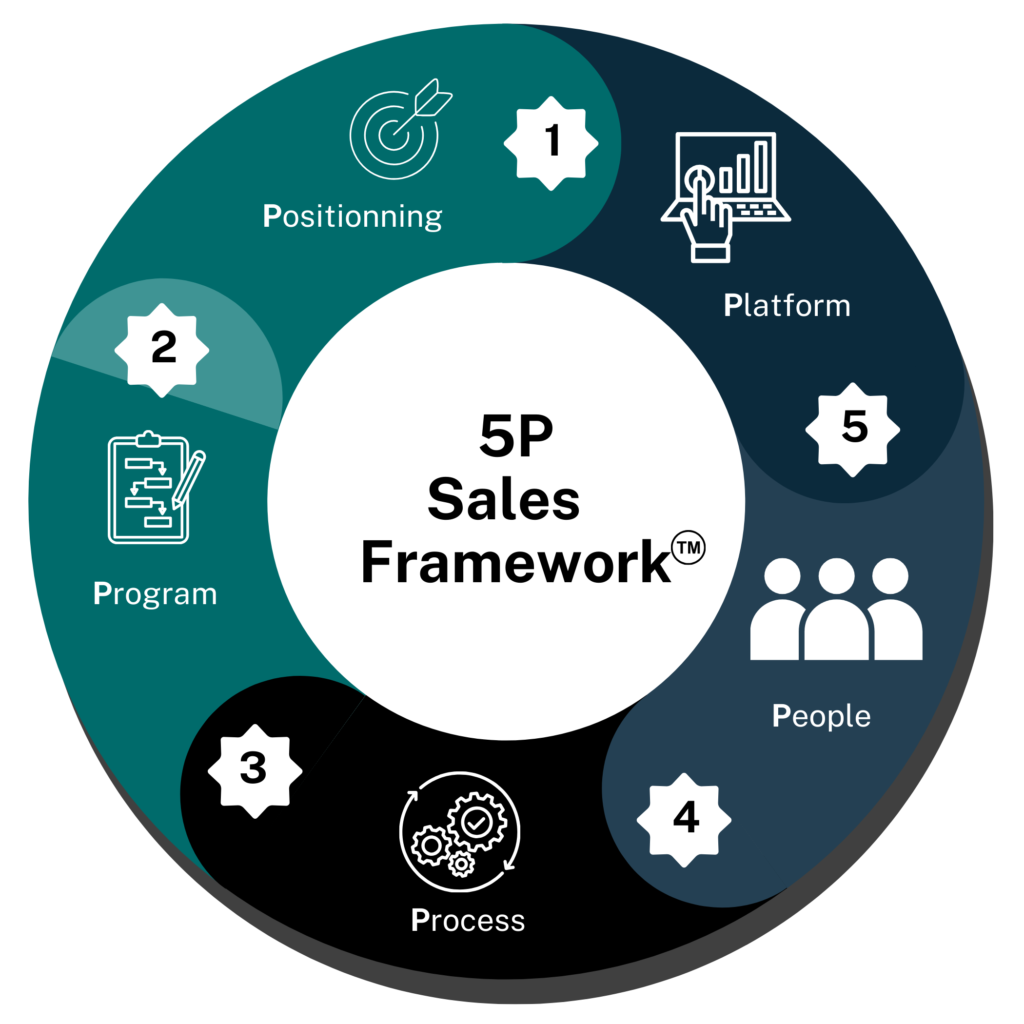
Dimension 1: Positioning
Positioning determines who you target and how you differentiate. Poor positioning manifests as pursuing wrong-fit prospects, competing primarily on price, or unclear value articulation across the sales team.
Core positioning questions include: Does your organization have a documented Ideal Customer Profile that sales references when prospecting? Can sales representatives articulate why qualified prospects should choose your solution over alternatives? Do win/loss patterns indicate you’re targeting customers where you have genuine competitive advantage?
Organizations with strong positioning demonstrate consistent messaging across sales team, compete in deals where they have structural advantages, and maintain healthy win rates without excessive discounting. Weak positioning results in scattered prospecting, price-driven competition, and sales representatives creating individual narratives rather than following coherent positioning.
Example from UAE technology sector: A Dubai-based SaaS company experienced 18-month sales cycles with 25% win rates despite strong product capability. Analysis revealed poor positioning—they pursued enterprises requiring extensive customization while their product served mid-market customers needing rapid deployment. Repositioning toward their natural fit reduced sales cycles to six months and improved win rates to 58% within two quarters.
Positioning establishes the foundation for all other dimensions. When you target wrong customers, no amount of process improvement or coaching delivers sustainable results because you’re competing where you shouldn’t.
Dimension 2: Program
Program encompasses sales organization structure, coverage model, territory design, and compensation. Poor program design manifests as unbalanced account loads, misaligned incentives, or coverage models that don’t scale.
Core program questions include: Does your territory or account assignment follow defined criteria balancing potential and capacity? Do coverage ratios between sales representatives and target accounts enable adequate attention to each customer? Does compensation structure reward behaviors that drive desired outcomes?
Organizations with effective programs demonstrate relatively consistent performance across sales team, clear accountability for specific accounts or territories, and compensation that aligns individual incentives with company objectives. Poor program design creates wide performance variance driven by unequal opportunity rather than capability differences.
Example from Saudi distribution: A Riyadh-based industrial distributor assigned territories geographically, resulting in one representative covering 40 accounts while another managed 180. The representative with 180 accounts achieved 45% quota attainment despite strong capability. Redesigning territories based on account potential and required coverage rather than geography balanced loads and improved overall team performance by 32%.
Program design determines whether your sales capacity can effectively cover your market opportunity. Even highly skilled representatives underperform when assigned unworkable territory loads.
Dimension 3: Process
Process defines how opportunities progress from identification through close, including qualification frameworks, pipeline definitions, and forecasting methodology. Poor process manifests as inconsistent qualification, unclear pipeline stages, or forecast variance above 30%.
Core process questions include: Do pipeline stages have defined entry and exit criteria that sales representatives consistently apply? Does qualification follow a structured framework ensuring only viable opportunities consume sales time? Do pipeline reviews occur regularly with clear accountability for forecast accuracy?
Organizations with mature processes demonstrate predictable conversion rates at each pipeline stage, forecast accuracy above 75%, and efficient sales cycles because representatives focus effort on qualified opportunities. Weak processes result in pipeline pollution, inconsistent forecasting, and sales representatives coaching deals they shouldn’t pursue.
Example from Johannesburg professional services: A South African consulting firm maintained high pipeline coverage but closed only 12% of forecasted deals. Investigation revealed no consistent qualification—representatives added any expressed interest to pipeline regardless of budget, authority, or timing. Implementing MEDDIC qualification reduced pipeline by 40% but increased close rates to 31% because representatives focused on genuinely qualified opportunities.
Process discipline determines how efficiently sales capacity converts to revenue. Without clear processes, representatives waste time on unqualified opportunities while viable deals receive insufficient attention.
Dimension 4: People
People addresses sales team capability, coaching effectiveness, and performance management. Poor people management manifests as inconsistent execution of defined processes, extended ramp time for new representatives, or lack of systematic skill development.
Core people questions include: Do sales representatives demonstrate proficiency in your qualification framework and sales methodology? Does coaching occur systematically based on specific performance gaps rather than ad-hoc feedback? Do onboarding programs enable new representatives to reach productivity within defined timeframes?
Organizations with strong people management demonstrate consistent process execution across team, clear performance improvement paths, and relatively predictable ramp time for new hires. Weak people management results in process adherence depending on individual representative discipline rather than systematic reinforcement.
Example from Qatar technology company: A Doha-based technology provider achieved only 40% quota attainment despite strong positioning and clear processes. Analysis revealed coaching focused on deal reviews rather than skill development. Representatives knew what to do but lacked capability to execute effectively, particularly in executive-level conversations. Implementing systematic coaching on executive engagement skills improved attainment to 73% over two quarters without changing positioning, process, or compensation.
People capability determines whether sales representatives can execute your defined methodology. Strong processes without adequate capability development produce inconsistent results.
Dimension 5: Platform
Platform encompasses CRM, sales enablement tools, data infrastructure, and technology integration. Poor platform manifests as manual data entry, disconnected systems, or tools that don’t support how sales actually works.
Core platform questions include: Does CRM provide visibility into pipeline health and sales activities without excessive manual entry? Do sales representatives access necessary customer information, content, and competitive intelligence when needed? Does technology enable or constrain sales productivity?
Organizations with effective platforms demonstrate high CRM adoption, minimal manual reporting, and sales representatives spending time on selling rather than administrative tasks. Weak platforms force representatives to work around systems rather than being supported by them.
Example from UAE manufacturing: A Dubai-based industrial equipment supplier invested significantly in CRM but achieved only 35% adoption. Investigation revealed CRM required 18 fields per opportunity, most irrelevant to actual sales process, while providing no mobile access for field-based representatives. Redesigning CRM to match actual workflow and enabling mobile access improved adoption to 84% and provided previously unavailable pipeline visibility.
Platform capability determines whether sales operations can scale efficiently. Manual processes and disconnected systems create administrative burden that reduces actual selling time.
How the 5 Dimensions Interact
The five dimensions form an interconnected system rather than independent factors. Constraints in one dimension often prevent improvements in others from delivering full impact.
Dependency patterns consistently emerge:
Positioning constrains everything else. When you target wrong customers, improving process, people, or platform cannot overcome fundamental positioning weakness. Organizations must establish sound positioning before other improvements deliver sustainable results.
Program design limits people effectiveness. Even highly capable representatives underperform when assigned unworkable territories or misaligned compensation. Address program constraints before investing heavily in capability development.
Process enables people development. Clear processes provide the foundation for systematic coaching. Without defined processes, coaching becomes opinion-based rather than methodology-reinforcement.
Platform amplifies process and people. Effective tools multiply the impact of good processes and capable people, but cannot compensate for unclear processes or insufficient capability.
This dependency model has important implications: fixing the wrong constraint first wastes time and resources without improving results. The most common mistake involves assuming people constraints when positioning, program, or process issues actually limit performance.
Sequential constraint addressing typically proves most effective: Establish sound positioning first. Ensure program design enables adequate coverage. Implement clear processes with defined qualification. Develop people capability to execute processes effectively. Deploy platform to scale proven approaches.
However, every organization presents unique constraint patterns. Some demonstrate strong positioning but weak process discipline. Others maintain effective processes but suffer from poor territory design. Systematic diagnosis identifies which constraint currently limits your specific situation.
Using the 5P Framework to Diagnose Sales Issues
The framework provides structure for identifying your primary constraint—the specific factor currently limiting growth.
Effective diagnosis follows this approach:
Step 1: Gather objective data across all five dimensions. Avoid opinion-based assessment. Use concrete metrics: win rates, forecast accuracy, ramp time, performance variance, CRM adoption rates, and conversion rates by pipeline stage.
Step 2: Identify symptoms and trace to root causes. Distinguish between symptoms and constraints. Missing quota is a symptom. Poor qualification that fills pipeline with unwinnable deals is a constraint. Wide performance variance is a symptom. Unbalanced territories that give some representatives structural advantages is a constraint.
Step 3: Assess dimension maturity. Evaluate each dimension against clear criteria. Strong positioning demonstrates defined ICP, consistent competitive win rates, and unified value articulation. Weak positioning shows scattered targeting and price-driven competition. Apply similar maturity assessment to each dimension.
Step 4: Determine primary constraint. Identify which dimension currently limits performance most significantly. This requires understanding dependency patterns. Even if people capability appears weak, positioning or process constraints may prevent capability development from improving results.
Step 5: Validate through cross-functional input. Effective diagnosis incorporates perspectives from sales, marketing, operations, and finance. Each function observes different symptoms that together reveal constraint patterns.
The diagnostic process typically requires two to four weeks including data gathering, analysis, and validation. Rushing diagnosis risks misidentifying constraints and implementing ineffective solutions.
Organizations serving Middle East and Africa markets should account for specific regional factors during diagnosis. Relationship-driven selling cultures, extended decision cycles involving multiple stakeholders, and seasonal business patterns during Ramadan all influence how constraints manifest and which improvements prove most effective.
Case Studies
Case Study 1: Technology Company (UAE)
A Dubai-based enterprise software provider experienced declining quota attainment—from 78% two years prior to 51% currently—despite hiring five additional sales representatives and investing in sales training.
Initial assumptions: Sales leadership attributed declining performance to representative capability and market saturation, leading to training investment and team expansion.
Diagnostic findings: The 5P assessment revealed strong people capability but significant positioning drift. Over 18 months, sales team had expanded target customer profile to include smaller accounts requiring extensive customization. This positioning shift created three problems: longer sales cycles as customization requirements lengthened evaluation, lower close rates as product fit weakened, and reduced account economics as customization costs consumed margin.
Root cause: Positioning—pursuing customers outside natural product fit.
Solution implemented: Repositioned toward original mid-market focus, implemented strict qualification criteria excluding customization-heavy opportunities, and redirected five newest representatives to inside sales covering smaller accounts with standard product.
Results: Within two quarters, quota attainment recovered to 73% with improving trajectory. Sales cycles decreased from 8.5 months to 5.2 months. Win rates improved from 22% to 41%. The repositioning and tighter qualification reduced pipeline coverage initially but dramatically improved conversion efficiency.
Key insight: Adding representatives and training could not overcome pursuing wrong-fit customers. Positioning clarity provided the foundation for other improvements to succeed.
For deeper exploration of quota attainment issues, see our guide on why sales teams miss quota.
Case Study 2: Distribution Company (Saudi Arabia)
A Riyadh-based industrial distributor maintained strong market position and product portfolio but struggled with forecast accuracy (56%) and inconsistent quota attainment across sales team (ranging from 35% to 142%).
Initial assumptions: Management attributed forecast inaccuracy to insufficient CRM discipline and performance variance to capability differences.
Diagnostic findings: Assessment revealed strong positioning and capable people, but two significant constraints: undefined pipeline stages (Process) and unbalanced territory design (Program). Representatives used CRM inconsistently because pipeline stages lacked clear definitions—one representative’s “negotiation” stage meant verbal interest while another’s indicated signed proposal. Territory design assigned accounts geographically rather than by potential and required coverage, creating structural performance variance.
Root cause: Process (unclear pipeline definitions) and Program (poor territory design).
Solution implemented: Defined clear pipeline stages with specific entry/exit criteria, implemented weekly pipeline reviews, redesigned territories based on account potential and required coverage rather than geography, and adjusted compensation to reward forecast accuracy.
Results: Forecast accuracy improved to 81% within one quarter as pipeline definitions enabled consistent forecasting. Performance variance decreased significantly—lowest performer improved from 35% to 68% attainment while highest performer maintained 128% through balanced territory loads. Total team quota attainment increased from 73% to 94%.
Key insight: Performance variance stemmed from unequal opportunity (Program) not capability differences, while forecast inaccuracy resulted from unclear process rather than CRM deficiency. Systematic improvements to Program and Process delivered results training could not achieve.
Case Study 3: Professional Services (South Africa)
A Johannesburg-based consulting firm achieved strong market reputation and healthy pipeline coverage (4.2x) but closed only 18% of forecasted opportunities, creating unpredictable revenue.
Initial assumptions: Leadership attributed low close rates to competitive pricing pressure and insufficient business development capability.
Diagnostic findings: Positioning and people capability tested strong, but process assessment revealed fundamental qualification weakness. Firm added any qualified lead to pipeline regardless of budget confirmation, decision authority validation, or genuine need urgency. Representatives spent 60-70% of time coaching deals that would never close while genuinely qualified opportunities received insufficient attention.
Root cause: Process—lack of systematic qualification.
Solution implemented: Adopted MEDDIC qualification framework, established clear qualification criteria for pipeline entry, implemented mandatory qualification reviews before proposal development, and trained representatives on effective discovery questioning.
Results: Pipeline coverage decreased initially from 4.2x to 2.8x as unqualified opportunities were removed. However, close rates improved from 18% to 47% within two quarters because representatives focused effort on genuinely qualified opportunities. Despite lower pipeline coverage, actual closed revenue increased by 34% because effort concentrated on winnable deals.
Key insight: Pipeline quantity masked qualification deficiency. Implementing systematic qualification reduced pipeline but dramatically improved efficiency and predictability.
FAQ: The 5P Sales Framework
How is the 5P Framework different from other sales methodologies?
Most sales methodologies—MEDDIC, Challenger, Solution Selling, SPIN—focus on seller execution within opportunities (the “how” of selling). The 5P Framework addresses sales organization design and constraint diagnosis (the “what” to fix). These approaches complement rather than compete. Organizations often implement the 5P Framework to diagnose constraints, then adopt specific methodologies like MEDDIC as their Process dimension solution.
Which dimension should we fix first?
Start with positioning assessment. Poor positioning undermines improvements in other dimensions. If positioning tests strong, evaluate program design before process, and process before people, following the dependency model. However, every situation presents unique patterns—systematic diagnosis reveals your specific primary constraint.
How long does it take to see results from improvements?
Timeline depends on which dimension you’re addressing and implementation scope. Process improvements like implementing qualification frameworks typically show impact within one to two quarters. Program changes like territory redesign may require two to three quarters to demonstrate full effect. Positioning shifts often need two to four quarters as sales team focuses on new target customers. People capability development generally requires sustained effort over three to four quarters.
Can we assess multiple dimensions simultaneously?
Yes, but implement improvements sequentially following dependency patterns. Attempting to fix all dimensions simultaneously dilutes focus and makes measuring impact difficult. Diagnose comprehensively across all five dimensions, then prioritize improvements based on constraint severity and dependencies.
Is this framework region-specific or globally applicable?
The framework applies globally, but implementation accounts for regional factors. For example, Middle East and Africa markets typically demonstrate longer sales cycles, relationship-intensive selling approaches, and multi-stakeholder decision-making. These factors influence how constraints manifest and which solutions prove most effective, but the underlying framework remains applicable. Successful implementation adapts to regional business culture while maintaining systematic diagnosis and improvement.
How often should we reassess our constraints?
Conduct comprehensive 5P sales assessment annually or when significant business changes occur (major strategic shift, market disruption, leadership change). Monitor key metrics quarterly to identify emerging constraints before they significantly impact performance. As you address one constraint, others may emerge as new limiting factors.
What if our primary constraint is unclear—multiple dimensions test weak?
This situation indicates either insufficient diagnostic rigor or genuine multi-dimensional weakness in early-stage sales organizations. Strengthen data gathering to enable clearer assessment. If multiple constraints genuinely exist at similar severity, start with positioning regardless, as it provides the foundation for other improvements. Then follow dependency model: Program before Process, Process before People, People before Platform.
Apply the 5P Framework to Your Organization
Understanding the framework conceptually differs from applying it to identify your specific constraints. Most organizations benefit from systematic sales assessment revealing which of the five dimensions currently limits growth.
The 5P Sales Diagnostic provides structured evaluation across all five dimensions, generating specific scores for Positioning, Program, Process, People, and Platform. The assessment uses scenario-based questions reflecting actual sales situations rather than opinion-based self-evaluation, producing actionable insight into your primary constraint.
The diagnostic process takes approximately 15 minutes and provides immediate results showing your scores across all dimensions, how you compare to similar organizations, and which constraint to address first based on your specific situation.
Regional sales assessments available for Middle East and Africa markets include:
UAE Sales Diagnostic addresses market-specific factors in Dubai, Abu Dhabi, and broader Emirates business environment including cultural calendar considerations and regional procurement cycles.
Saudi Arabia Sales Diagnostic accounts for Kingdom-specific dynamics including relationship building requirements, decision-making hierarchies, and Riyadh/Jeddah market characteristics.
Qatar Sales Diagnostic reflects Doha’s concentrated market environment and project-based buying patterns common in Qatari business.
South Africa Sales Diagnostic incorporates African market factors relevant to Johannesburg, Cape Town, and broader South African business contexts.
MEA Regional Diagnostic addresses general Middle East and Africa business dynamics for companies operating in Egypt, Moroccco, Nigeria, Kenya, and other regional markets including extended relationship cycles, multi-stakeholder decision complexity, and cultural considerations.
Each regional diagnostic applies the core 5P framework while incorporating market-specific considerations that influence how constraints manifest and which solutions prove most effective in that geography.
Conclusion
Sales improvement begins with accurate diagnosis. The 5P Sales Framework provides systematic approach to identifying which constraint currently limits your growth—Positioning, Program, Process, People, or Platform.
Most organizations default to familiar solutions without diagnosing root causes. They assume quota misses stem from people issues, invest in training and hiring, then experience disappointment when results don’t improve. This pattern repeats because symptoms receive attention while constraints remain unaddressed.
Effective improvement requires understanding which dimension actually limits performance and following logical dependency sequences when implementing changes. Positioning provides foundation. Program design determines whether capacity matches opportunity. Process defines how that capacity converts to revenue. People capability determines execution quality. Platform enables scale.
Organizations that systematically diagnose constraints, prioritize improvements following dependency patterns, and measure impact demonstrate predictable sales performance improvement. Those that guess at solutions based on symptoms continue experiencing unpredictable results regardless of effort invested.
The framework doesn’t guarantee specific outcomes—too many factors influence sales performance. However, it significantly improves the probability that improvement efforts address actual constraints rather than symptoms, making progress more likely and resource investment more efficient.
Begin with systematic sales assessment. Identify your primary constraint. Implement targeted improvements. Measure impact. Reassess as constraints shift. This disciplined approach builds predictable revenue generation capability over time.
Pingback: How to Improve Sales Forecast Accuracy in UAE Technology Companies -
Pingback: Sales Pipeline Management Best Practices for Saudi Arabia B2B Companies -
Pingback: How to Define Your Ideal Customer Profile (ICP) for B2B Sales in the GCC -